Kyrio · Kids allowance app

Kids allowance app — chores, rewards, and money, without the bank

Greenlight charges $5 a month for a debit card you didn’t ask for. GoHenry is the same model. Kyrio is the kids allowance app that just tracks what you pay — chores to points to cash or non-cash rewards, your bank stays out of it, and it’s free.

  • Points-based system with chores → rewards (cash or not — your call)
  • Optional allowance tracker, opt-in per child
  • Works without a bank, debit card, or monthly fee
  • Free on iOS and Android, GDPR-first, no ads

Oppdatert 3. mai 2026

Kyrio kids allowance app — redeem points for rewards parents set

Chores → points → money (or whatever you actually use)

Most parenting researchers (including the AAP) recommend a hybrid allowance model: a small base that’s not tied to chores, plus optional paid jobs above and beyond. Kyrio models both. A daily chore pays points. Points convert to what you actually hand over — dollars, kroner, screen-time minutes, a trip to the pool.

The app tracks the balance; you handle the payout. That sounds trivial, but it’s exactly why the kids-with-debit-card apps keep you locked into $5/month — they exist to move real money because they have to justify the bank integration. Kyrio doesn’t.
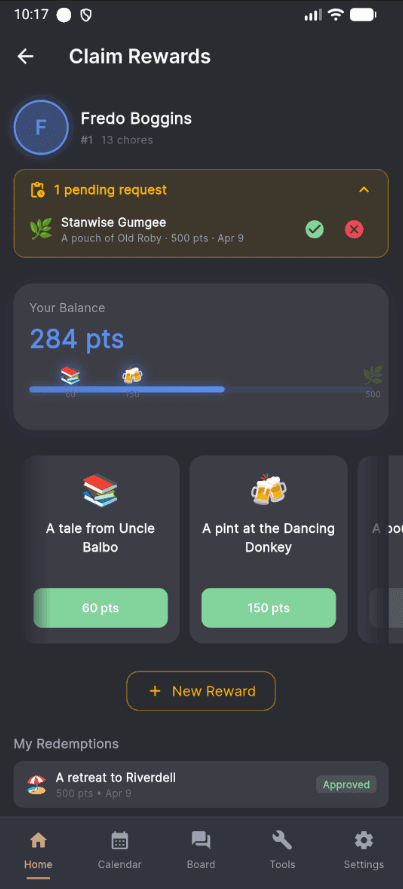
Kids redeem points for rewards in Kyrio

Age-appropriate from 4 to 17

A 6-year-old doesn’t need a debit card. A 13-year-old doesn’t need a sticker chart. Kyrio defaults to a different presentation per age band: icon-based rewards for younger kids, real currency amounts for teens, and a simple parent-adjustable mix in the middle.

For the specifics, see the age-by-age guides we wrote: chores for 6-year-olds, 8-year-olds, and teenagers. All three include the allowance conversation for that age.

Parents pay when parents pay — no automated transfers

Kyrio doesn’t touch your bank account, doesn’t ask for your kid’s social security number, and doesn’t send real money automatically. When a reward gets redeemed, you get a notification. You pay cash, Venmo them, transfer to their savings account — however you normally do it.

This is a feature, not a bug. Most families don’t need another fintech intermediary. They need a ledger the whole family trusts. That’s what this is.

The best allowance rewards aren’t always money

For kids under 10, we see the highest motivation come from non-money rewards: picking the next movie, choosing breakfast, an extra bedtime story, a sleepover. For teenagers, money wins more often. Kyrio lets you mix both freely — the 6-year-old can spend points on “choose dinner,” the 13-year-old can spend points on “$10 toward new AirPods.”

Read more in our ADHD-friendly chore chart guide — the same instant-payout principles apply even better to kids with ADHD.

Slik sammenlignes Kyrio

FeatureKyrioGreenlightHomeyJoon
Allowance / money rewardsConverts chores or points into tracked allowance money.Partial

Points convert into parent-defined rewards; custom reward types can represent allowance money.

YesYesNo
Parent-set reward storeParents define custom rewards; kids redeem with earned points.YesNoYesPartial
Points & leaderboardsPoints, streaks, badges, or a family leaderboard that motivate kids.YesNoYesYes
Chore templatesPre-built age-appropriate chore lists you can assign with one tap.YesPartialYesYes

Klikk på et navn for full sammenligning på bloggen.

Vanlige spørsmål

Does Kyrio issue a debit card?
No, and that’s intentional. Greenlight, GoHenry, and BusyKid all make money from the bank-card part of the product, which is why they cost $5-10/month. Kyrio is free because we don’t need to run a card program. You pay the kid the way you already pay the kid; we track the balance.
Is the allowance tracker free?
Yes. Points, chores, rewards, the full ledger — all free. No “Allowance Pro” upsell.
Can I pay allowance that isn’t tied to chores?
Yes. Kyrio supports a weekly base allowance that pays regardless of chores done (the “family-citizenship” part of allowance) plus optional paid chores on top. Most parenting research recommends this hybrid; the app matches it.
What age should kids start getting an allowance?
Most researchers suggest age 6-7 for a tiny weekly amount, then scaling with age and responsibility. Before that, non-money rewards work better — young kids don’t connect abstract numbers to purchasing power yet. Our age-by-age guides cover this in detail.
Can I link it to my bank or use it with Venmo?
No direct integration — intentionally. You can still Venmo or bank-transfer the kid when you pay out; Kyrio just records it. For most families, this is less friction than onboarding a new fintech into the household.
What if the kid doesn’t want to do chores to earn allowance?
That’s the parenting decision, not the app’s. Kyrio supports chore-tied rewards, flat weekly allowances, and hybrids. If you don’t want to tie them, don’t tie them. The app doesn’t insist.
Does this work for teens who have their own debit card already?
Yes. Kyrio tracks what they’ve earned; they spend it wherever. Many teens get their first debit card around 13-14 through their parents’ bank — Kyrio is the ledger sitting on top of that.